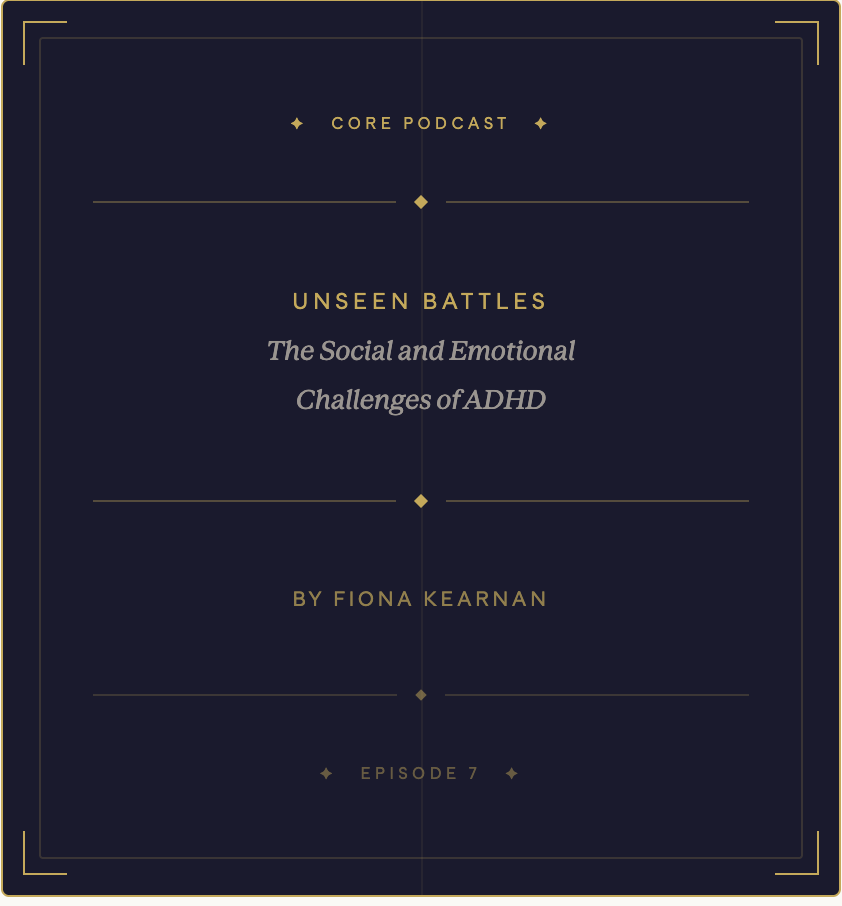

A conversation with Fiona Kernan, author of Unseen Battles: The Social And Emotional Challenges of ADHD (for purchase here)
There is a particular kind of irony that only ADHD can produce.
Fiona Kernan spent three decades in classrooms across Australia — teaching, researching, advocating fiercely for students whose brains worked differently. She became one of her country’s foremost voices on ADHD education. She wrote the book that teachers actually needed — literally. And she was, by her own description, one of the most punctual and organized people you could ever meet.
So naturally, she had ADHD the entire time.
She just didn’t know it yet.
Her daughter figured it out first.
“I’m an expert. I don’t have ADHD.”
When Fiona’s youngest daughter came home from school one afternoon — having compared notes with her neurodivergent friends — and announced that her mother probably had ADHD, Fiona’s response was immediate and confident.
No. Absolutely not.
“I said, people with ADHD are late, are disorganized, and they forget things and lose things. And I don’t do any of those things.”
It took twelve months, a social media feed full of middle-aged women finally getting diagnosed, and a psychiatrist who told her she’d spent her whole life coaching herself, and that that was completely amazing — before she believed it.
This is exactly the story that doesn’t get told enough. Not the hyperactive little boy bouncing off classroom walls. The high-functioning, organized, punctual woman who built an entire career around a condition she had in her own brain — and missed it completely.
The running commentary nobody talks about
One of the most vivid moments in our conversation — and in Fiona’s book, Unseen Battles — is the question she and another woman asked a stranger in a medical waiting room.
“Excuse me — do you ever have moments when your brain is just quiet? Not thinking about anything?”
The woman said yes, all the time.
Fiona and her companion stared at each other.
What would that even feel like?
For women with ADHD, particularly those who present without the obvious hyperactivity, the experience isn’t external chaos. It’s internal noise. A running commentary. Multiple radio stations playing simultaneously, some loud, some quiet, none of them the one you’re supposed to be listening to right now.
When Fiona tried Ritalin briefly after her diagnosis, it turned the commentary off.
She found it lonely.
“I had gone for 50 years having these running commentaries. When I didn’t have them, it was almost lonely.”
Why girls keep getting missed — and why it’s still happening
Fiona is careful here: things are improving. But the fundamental problem hasn’t gone away.
For decades, ADHD was considered a boy’s condition. The diagnosis required the thing you could see — the physical energy, the disruption, the inability to sit still. And for many girls, ADHD doesn’t look like that. It looks like daydreaming. Like a very busy, very private inner world. Like a student who is clearly smart but somehow just… elsewhere.
Nobody noticed. Because there was nothing to notice. The chaos was invisible.
The cost of that invisibility? Anxiety. Depression. Decades of believing the problem was a character flaw rather than a neurological difference.
“The depression and anxiety that I had perhaps wouldn’t have been as significant,” Fiona told me, “had I known that my brain just perceived the world differently.”
The part nobody writes about: RSD, justice sensitivity, and crying in the bathroom
Here is what I love most about Unseen Battles, and why I think it belongs on every late-diagnosed woman’s nightstand.
Most ADHD books focus on productivity. Executive function. Systems for getting things done. And those books are useful — but they were written by and for a particular presentation of ADHD that many of us simply don’t recognize ourselves in.
Fiona wrote the book for the other ones. The ones whose biggest challenges aren’t losing their keys. They’re losing their composure when something feels unfair. They’re replaying a conversation at 2am trying to figure out what they said to make someone pull away. They’re crying in the office bathroom after a disagreement — not because they’re weak, but because their nervous system processes rejection and injustice at a frequency most people don’t operate on.
Rejection Sensitive Dysphoria. Justice sensitivity. Emotional dysregulation that doesn’t show up in any diagnostic checklist but runs quietly underneath every relationship, every workplace, every Christmas dinner with three undiagnosed ADHD women around the same table.
(Her story about that Christmas Day is worth the price of the book alone.)
“Even though I can label it — that’s my RSD — it doesn’t make it any easier,” she told me. “I still go over and over. What did I say that upset that person?”
The label helps. The awareness helps. But it doesn’t make the feeling smaller. What does help, she says, is finding people who understand it from the inside.
On perimenopause, estrogen, and thinking you have dementia
This is the part of our conversation I want every woman in her forties to hear.
Fiona — organized, strategic, fully-functioning Fiona, with decades of self-built coping tools — hit perimenopause and thought she was losing her mind.
“I actually thought I was getting dementia.”
She wasn’t. Her estrogen levels had dropped, and estrogen and dopamine are deeply connected. The strategies she’d built over a lifetime to keep everything running? They stopped working. Not because she’d failed — because the neurochemical environment they were built on had shifted underneath her.
Once she addressed the estrogen deficiency, the strategies worked again.
This is not a small thing. This is the piece of the puzzle that explains why so many women fall apart in perimenopause in ways that feel completely disproportionate to what’s actually happening in their lives. They’re not falling apart. The scaffolding changed.
Find your people – Find your tribe
If there is one through-line in everything Fiona said, it’s this.
Get diagnosed if you can. Learn the language. Understand what’s actually happening in your brain. But then — find the people who get it.
“Finding your tribe, people who absolutely just get it — you can laugh about it, you can cry about it, you can share stories. That’s been my saviour.”
Not because community fixes the hard parts. But because being understood — actually understood, not just tolerated or accommodated — changes what the hard parts cost you.
Hey, Read the book
Unseen Battles: The Social and Emotional Challenges of ADHD by Fiona Kernan is the book I wish I’d had decades ago. I laughed. I teared up. I took notes in the margins like I was studying for something important.
Because I was.
If you’ve ever felt like the ADHD conversation wasn’t quite written for you — if you’re organized and punctual and high-functioning and still somehow struggling in ways nobody seems to have language for — this book has your name on it.
You can find Fiona and her work [here].
And if you haven’t listened to our conversation yet, Episode 7 of CORE is waiting for you.
Listen on: Apple Podcasts
Listen in on: Spotify
CORE with Libby Andrew is a podcast for high-achieving women navigating late ADHD diagnosis — and building the life their brains were always capable of. New episodes every Thursday and sometimes a bonus on Tuesday.







Comments +