
The Beginning of Something That I couldn’t Unsee. . .
Begin at the beginning,” the King said, “and go on till you come to the end: then stop.” – Alice In Wonderland
So I’ll begin at one of the scenes that rewrote my life in hindsight.
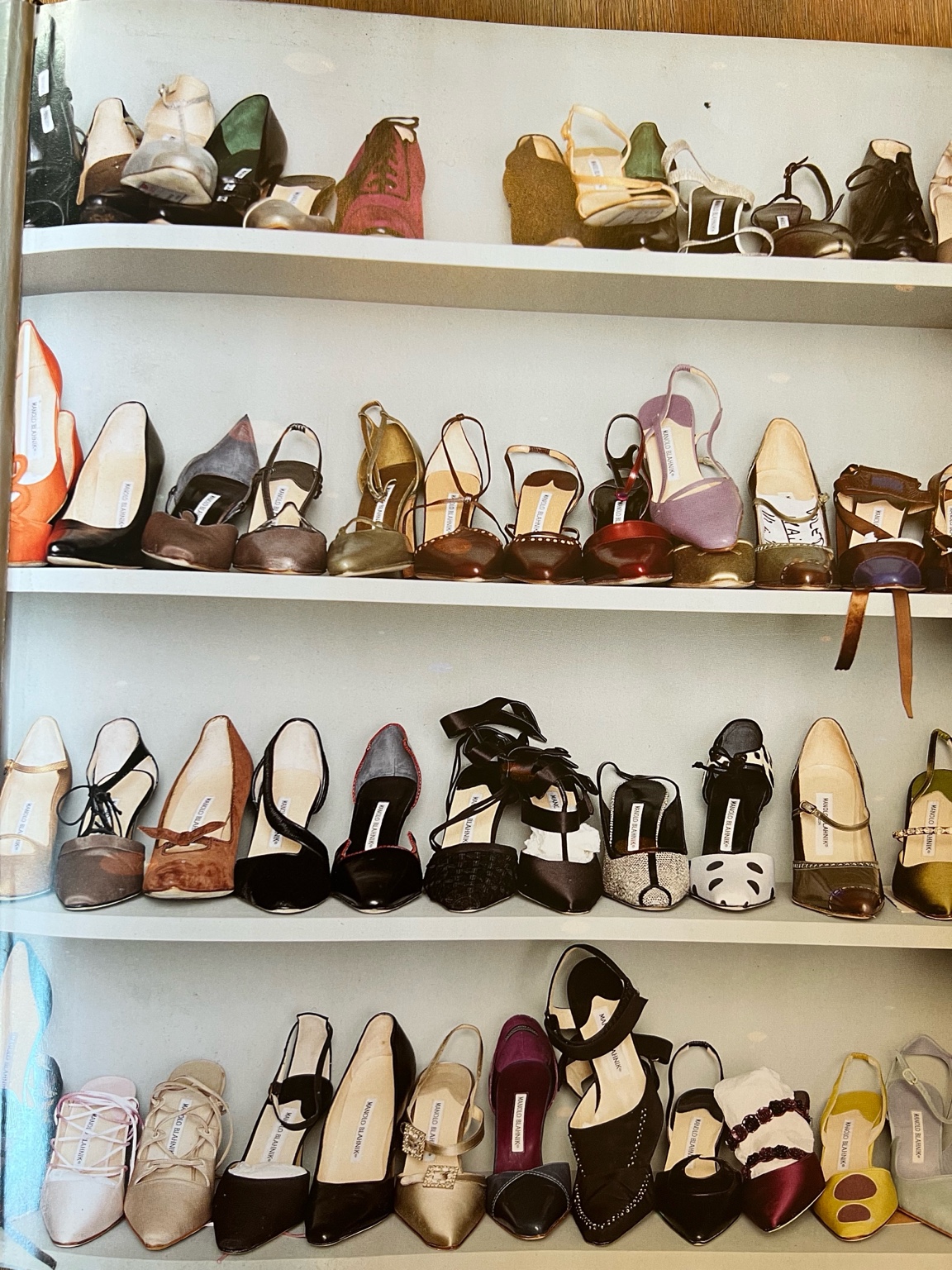
I was running back from Trudi’s office in my Manolos – the sharp click-click clack echoing down the glossy hallways, Editor’s offices strewn with towering books and Sotheby’s catalogs, stacks of look-books and mood-boards – when I saw her…
Anna Wintour, my boss, standing at my desk flipping through my notebook.
My stomach dropped. This was not a typical behavior for her.
On the outside, I was the perfect Voguette — calm, polished, wrapped in Theory and Helmut Lang with the faint smell of YSL Paris lingering from the morning spritz.
Inside? Not panic, exactly, never panic actually or even anxiety, dialed-in laser-focused. (One might refer to this as hyper-focus.) Curiosity that hummed like the constant buzz of printers and phones in the open-plan office, I had a fierce drive for the world of fashion, it was inextricably aligned with my endless curiosity.
In the Vogue editorial offices, where the air thrummed with urgency, mixed with the aroma of fresh peonies from Miho Kosuda’s deliveries and the glossy rustle of page proofs being flipped.
My notes made sense to me… but would they pass the Anna test? Anna did not look up. She read slowly, silently. Flipping pages, cool, deliberant.
Then finally lifted her gaze to mine – those signature sunglasses perched just so, framing eyes that could approve a cover or end a career in a glance.
Ten… maybe fifteen seconds of eye contact.
There were pages of details separated like a family tree:
- “Call Oscar.”
- “Call Mario at Donatella’s.”
- “Book Lunch, 44/44 or is it 57/57.”
- “Check Reservation, Four Seasons, Paris.”
- “Call in Lookbooks: Gucci, Prada, YSL, Celine, Burberry.”
- “Get National Gallery photos for Bee.”
- “Contact: Lisa Love.”
- “Wimbledon Tickets (Jeffery).”
- “Miho Kosuda. NO orchids, just peonies.”
- “Contact Charles on travel piece — Editor or Father?”
- “Add Barbara Diamondville von Speil Bogle… never heard of her… who?”
You get the idea… this was a typical hour most days. Three pages. One hour. My notes were perfect for me.
Written in print, some cursive, some doodles, some caps, some exclamation marks — and an order that, well, let’s just say, I had my method.
Some might call it a bit chaotic. But for me it was absolute clarity.
My head kept track of everything unwritten — events, dates, times, phone numbers.
Fine. I loved it.
NOTE: This is a compliment I want to give to Anna, she had created a haven for many creatives, unbothered by obscurity and the abstract nature of every kind of creator you could possibly imagine extending well beyond fashion and photography – artist, writers, journalists, poets, business moguls and politicians etc.
She flipped the pages back to the beginning, turned, swan-like, and said to the other assistant:
“Melissa, could you get my father on the phone please? And make reservations for lunch next Wednesday at 57/57.”
She walked away. I exhaled.
Looking back, I see it now:
My brain was curated for me as extremely reliable, of course— and Anna, whose life depended on our mastery of her details both personally and professionally, she might want to see it less abstract on paper. But she never complained, in fact when I left Vogue she wrote me a personal note that said, “You will be good at whatever it is you decide to do.” – Some words hang unforgettably in the air for decades to come.
I believed that my brain’s rapid thought-fire — my buffer for every possible thing that could or might happen — was like a fuzzy electron cloud swirling the nucleus of what actually did happen.
And… that everyone lived like this.
My way of taking a break? Daydreaming. That might sound indulgent for some, and disastrous at a place like Vogue, but for me falling into my imagination for a bit was the perfect re-charge. It was my form of meditation. I had done it all my life, in school, uncomfortable conversations, too many hours at church. . . Boring lectures in college etc.
And Vogue provided options for “meditation” on steroids.
(Think: ballgowns, Met Galas with celebrities air-kissing under chandeliers, writers pitching stories amid clacking keyboards, gorgeous models striding in with portfolios tucked under arms, shoes — forever shoes — flowers blooming in every corner like a perpetual Spring.)
Perpetual Spring
But here’s why it worked so beautifully, in a way no other job ever quite did: Vogue was a constant cascade of novelty and sensory input that matched my brain’s wiring perfectly. Every day brought fresh challenges – coordinating shoots with photographers like Mario Testino, where the studio filled with the flash of strobes and the scent of hairspray; pulling looks from designers I’d only dreamed about, feeling the silk and paillettes slip through my fingers; or juggling last minute changes for events that felt like high-stakes theater, with the adrenaline rush of a curtain call. It wasn’t just busy; it was alive with variety, creativity, and urgency that kept my dopamine flowing without me even trying.
A Gift I did not know was a Gift
What truly anchored it all, though, was the extreme military-like structure that I’d never experienced before – Anna arriving at the exact same time most days, following the same predictable schedule down to the routes we took, with certain meetings locked in on specific days at precise hours. That reliability, combined with her insistence on absolute silence in and around her office, created a sanctuary of peace amid the glamour. No constant interruptions from noisy chatter; just focused quiet that let my mind settle for the first time. I thrived in that atmosphere, I was lightning fast at my tasks, often wrapping up the bulk by 10am, leaving plenty of space for the daydreaming that recharged me. The enforced consistency extended to everything: pick-ups and drop-offs at set times 90% of the day, turning what could have been frenzy into a rhythmic flow that worked miracles for my brain.
As Anna’s full time assistant – the exact role you see (and dramatized) in The Devil Wears Prada – I thrived on the hyper-focus that kicked in during those whirlwind moments. I’d train the next assistant showing them how to anticipate needs before they were spoken; how to navigate the unspoken hierarchies of the fashion world, from schmoozing publicists at after-parties pulsing with bass to whispering updates during fittings where pins pricked and fabrics whispered. My pattern recognition let me connect dots others missed: remembering a designer’s full line from – large gold buttoned, lapel coats to a passing comment amid the chaos of Fashion Week tents, or linking a random hiccup in a journalists life to an opportunity for a story pitch while the office hummed with deadline energy.
Polish and Precision
Sure, it demanded polish and precision, but beneath that, it allowed my creativity to roam free – imagining narratives around every runway show – who is the woman strong enough to wear these clothes – from models heels thudding like heartbeats or editorial spreads that unfolded like visual poetry on oversized monitors. Unlike the linear drudgery of Middle School and High School or later corporate gigs, Vogue rewarded my non-linear thinking. It was the rare environment where my “abstract scaffolding” wasn’t a liability; it was an asset. The constant pivot, from a Paris booking gone awry to sourcing a rare vintage piece overnight, felt like a thrilling game, not a grind. If I’d known about my ADHD back then, I might have leaned into it even more, but hindsight shows me it was a perfect storm of stimulation that let me shine without burning out.
I enjoyed doing what it took-
soft, discreet, confident, demure, polished. No problem.
That was simply the standard for playing at that level.
Only later did I learn that this was a form of masking.
At the time, I assumed everyone did it.
I was wrong.
It wasn’t about chasing success.
It was about a mind wired for depth, movement, and meaning, looking for the environment it was built to thrive in.
Later that day, a phone call came from her husband, Dr. Schaffer — Director of Child Psychology at Columbia University.
“Libby, have you ever been tested for a learning disability?”
The Pattern I Couldn’t See Then
In the years since, I’ve replayed that day more times than I can count.
How did she know?
How did no one else before her — not teachers, not professors, not my parents — ever once think:
Can write an essay with a detail-perfect layout of Economic Stress in America and theories to support… but can’t answer the multiple choice.
No one thought, “maybe she thinks differently”? Or maybe I was competent in a way that questioning seemed like an insult. Here-in lies the paradox of this particular diagnosis or brain orientation.
Looking back, the signs were everywhere:
- Standing at my desk all of fifth grade — I thought better standing.
- Beating my Harvard chess captain grandfather at age seven.
- One hour late for my journalism exam, my favorite subject
- Turning in papers full of weird errors because I didn’t think it was important to re-read them
- Being told I was “out to lunch” a lot
I didn’t call this anything.
I thrived by looking for novelty and beauty in anything and everything, and by making up cinematic stories in my mind.
In school I often felt bored to tears and would complain to my Mother. She said, “There is no such thing as boredom just wasted time and a lack of interest.”
I felt: creative.
Stubborn.
I had typical teenage and twenty-something frustrations with learning about the world.
That’s it.
I also noticed that adults enjoyed creating labels that were fixed, not the paradox of a mind with VAST or (ADHD). And to their credit we simply did not have the information we now have about VAST. If their methods for teaching were in affective it was the “child who had a problem.” Therefore I wasn’t letting anyone — not anyone — into my brain.
So they could make me out as someone I wasn’t?
I wasn’t available for some adults to attach a meaning to my life that was likely inaccurate at best.
No thank you.
And Then… Hollywood and Years of Undiagnosis
By my late twenties I was in Hollywood working for Ron Howard and Brian Grazer. Another dream job. I wanted to learn how to make movies, because storytelling, great storytelling the way Ron Howard does it, is what got me through much of my childhood. I wanted to learn how to do it from the best in the business. Besides Raiders of The Lost Ark and JAWS, most of my favorite movies were Produced by Brian Grazer and Directed by Ron Howard. (there is so much more to this story then this post has time for. . .To be continued at a future date.)
I absolutely loved every minute of working at Imagine Entertainment. So why would I keep leaving my dream gigs?
In Hollywood, the level of excellence is real.
You’re working alongside creative and business leaders who shape how the world sees itself — and I learned quickly how to meet that standard with focus, presence, and precision.
When criticism appeared, or an ethical tension surfaced, my instinct wasn’t to retreat — it was to recalibrate.
I took everything seriously because I cared deeply about the integrity of the work and the people in the room.
Only later did I recognize that my sensitivity in those moments had a name:
Rejection Sensitivity Dysphoria (RSD) — a heightened emotional response that often accompanies high-capacity ADHD minds.
Understanding that changed everything.
I didn’t make changes impulsively — I thought them through, tested every possible reason to stay, and eventually reached a simple conclusion:
my mind could not remain in a life that no longer made sense to it.
I learned that I only function well when my work channels my creativity and connects me to purpose — the way water sustains the body.
When that alignment disappears, I don’t collapse… I realign.
I was never abrupt.
I learned to move between chapters with care — entering fully, and when the time came, exiting just as thoughtfully.
Just like Vogue.
Just like certain relationships.
For years, my family joked that I was “the coast-to-coast roller coaster.”
In hindsight, it was simply an ADHD nervous system searching for the right scale of life.
This is where what’s often called masking becomes visible — not as pretense, but as restraint.
Not hiding who you are, but carefully editing yourself to fit the moment, the room, and the people around you… often at your own expense.
Understanding that pattern changed everything.
And once I saw it clearly, I could finally build a life that no longer required it.
I needed something different.
A new challenge, a new place, someplace where I wouldn’t feel stuck.
Motherhood Made Everything Impossible to Ignore
Motherhood changed the terrain completely.
The highly structured world I had learned to navigate — the rhythm, the standards, the feedback loops of Vogue and Hollywood — no longer existed. I tried, at first, to recreate that same architecture inside a life defined by unpredictability, emotional intensity, and constant motion.
It was like standing on a mountain I had learned to climb expertly… and discovering that the ground beneath it had shifted.
That’s when I first understood what a crevasse truly is —
not a failure of the climber,
but a natural fracture formed when powerful forces move at different speeds over uneven ground.
A crevasse is a deep crack or fissure in a glacier or ice sheet, formed by stress from the ice moving over uneven ground or at different speeds creating dangerous openings often hidden by snow bridges, posing serious risks like falls, hypothermia, and being life-threatening for climbers – National Geographic
I didn’t feel like I was falling.
I felt like the structure I had relied on no longer fit the environment.
Years later, in my early forties, I called Dr. Ned Hallowell — author of more than twenty books on ADHD and one of the most respected minds in the field. I was calling about my son. Somewhere in the middle of the conversation, he said calmly:
“Libby, it’s very likely that you have ADHD as well.”
I laughed it off.
I was driving with the windows down, sunroof open, a life in full motion.
The kids felt more urgent than me.
I told myself I’d circle back.
At forty-eight, sitting in a pediatrician’s office filling out my son’s ADHD assessment, I realized something startling:
I had more “yes” answers than he did.
Dr. Hallowell’s words came back, verbatim.
Suddenly I saw my life through a new lens.
Not as disorder — but as design.
Forms had always felt like torture.
Appointments felt optional unless deeply interesting.
An afternoon reset wasn’t indulgent — it was necessary.
The culture of “mommy wine” felt dangerous, not casual.
Being called “Mom” at all Doctor’s offices instead of my name made me feel the depth of invisibility that Moms regularly endure.
These weren’t character flaws.
They were patterns of a high-capacity nervous system that had never been named.
Eventually, when the monotony and logistics of daily life began to compress everything I was, and when I watched my son’s world expand with remarkable ease after his diagnosis, I went back to base camp.
I chose to understand my own terrain.
I completed full neuropsychological testing — not because I doubted myself, but because I wanted clarity that was unarguable.
Years earlier, before hiring me, Brian once said:
“I can’t quite figure out what you’re like.”
At the time, I thought it was an odd thing to say.
Now I understand exactly what he meant.
The Diagnosis That Finally Explained Everything
Then everything finally clicked.
The picture that emerged was unmistakable:
a predominantly inattentive ADHD profile,
exceptional pattern recognition,
and a level of sensitivity and cognitive horsepower most people never have to manage.
For decades, I had instinctively learned how to meet each moment —
polished when required, efficient when needed,
engaging in one room, quiet and focused in another,
creative on stage, precise in conversation.
Not because anything was wrong —
but because that’s how a high-capacity mind navigates complex environments.
This wasn’t a flaw.
It was a wiring.
And it finally had a name.
Now What?
That is why I’m writing this.
Why I built this work.
Why I coach women who recognize themselves here.
Brilliant, capable, intuitive women who were never truly seen in childhood — and who now find themselves carrying a life that doesn’t quite match the scale of their mind.
Because ADHD (or VAST, as some describe it) is not a flaw.
It’s a capacity.
What most women were never given was the compass for how to use the map they were born with.
When a woman finally understands her wiring, the world opens again.
Clarity returns.
Momentum follows.
I’m here to help you build a life that fits your mind —
with strategies designed for how you actually think, work, and create.
If this resonates, let’s talk.
P.S. Yes — I really did have the job you see in The Devil Wears Prada.
Later, I moved into the Fashion Office. It was both nothing like the movie… and somehow, exactly like it.






Comments +